Owner on every job
French drains and yard drainage in Charlotte
French drains, grading and downspout extensions that move water away from your house and dry out soggy lawns.
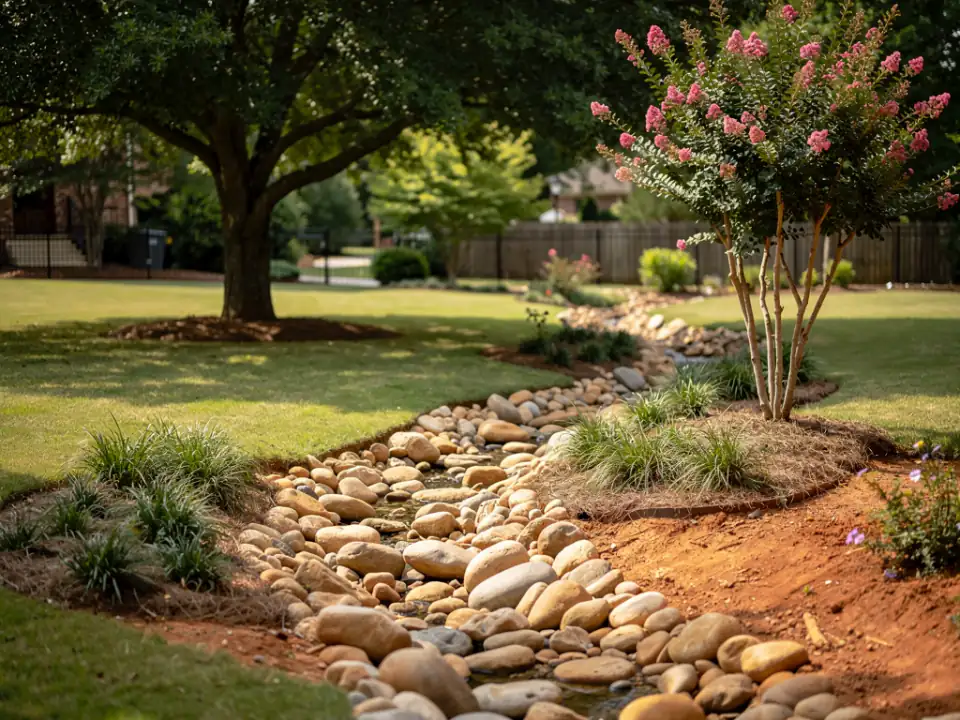
- Owner on every job
- Licensed NC landscape contractor
- $2M general liability
- 2-year hardscape warranty
French drain installation in Charlotte and other yard drainage fixes
If your yard stays soggy for days after rain, we install French drains in Charlotte and correct the grading and downspouts that send water where it should not go. The goal is simple: water leaves the yard on a path we choose, instead of sitting on the lawn or running toward the house.
Water problems rarely fix themselves. Left alone, they kill grass, wash out beds, leave standing water for mosquitoes and, worst of all, push moisture toward your foundation or crawl space. Marcus Hale looks at every drainage job himself, and one crew does the digging, piping and lawn repair.
We fix drainage across south Charlotte, Ballantyne, Myers Park, Dilworth and SouthPark, and out to Pineville, Mint Hill, Cornelius and Indian Trail. Whether the house is new or decades old, standing water usually comes down to the same few causes, and so does the way we track them down.
- French drains that collect water and carry it away underground
- Regrading so the ground slopes away from the house
- Downspout extensions that move roof water to a safe outlet
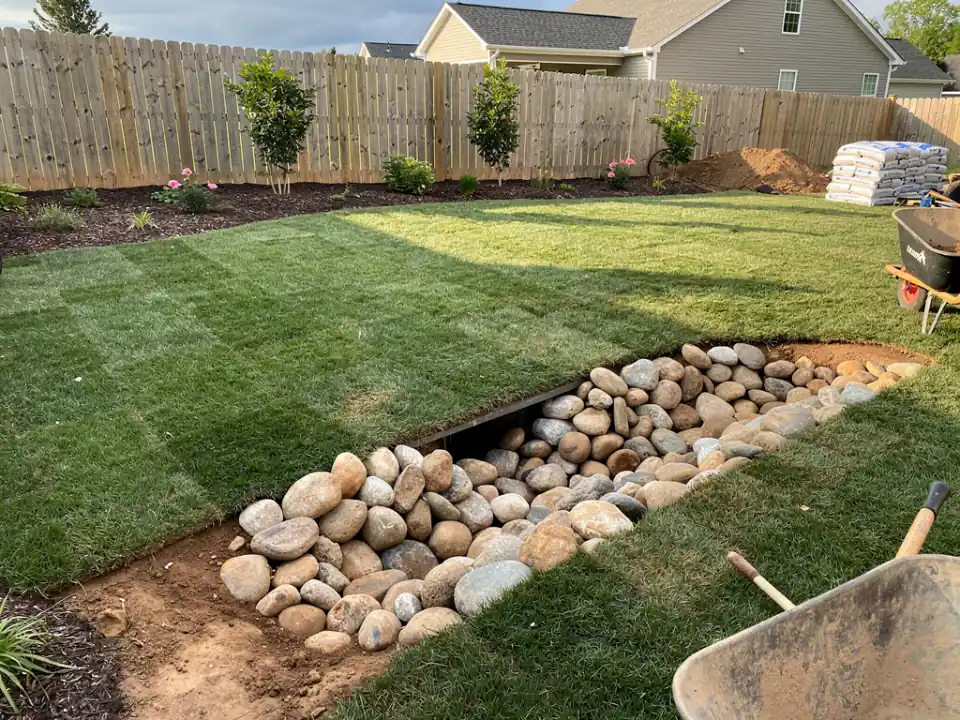
- River-rock outlets at the edge of the yard
Signs your yard needs better drainage
Most of these signs trace back to one of three causes: grading that slopes the wrong way, roof water released too close to the house, or clay that cannot soak up a heavy rain. We work out which it is before we recommend anything, because a drain in the wrong place only moves the problem.
The best time to see the problem is during or right after a storm. If you can, take photos or a short video of where water runs and pools, and show us at the estimate. It often tells us more than a dry yard can.
- Puddles still sitting there a day or two after rain
- Bare, muddy patches or moss where grass used to grow
- Mulch and soil washed out of beds after a storm
- Water pooling against the foundation, or a damp crawl space
- Downspouts that empty straight onto the lawn beside the house
French drain, regrading or downspout extension: which fix is right?
A French drain is a trench lined with filter fabric, holding a perforated pipe bedded in washed gravel. Water seeps into the gravel, enters the pipe and runs downhill to an outlet. It suits low spots that collect runoff and long stretches where water moves across the yard.
Regrading reshapes the ground itself so it falls away from the house, and it is often the right answer when soil next to the foundation has settled into a dip. Downspout extensions are the simplest fix: a buried pipe carries roof water to a spot where it can spread out safely. Many yards need a mix of all three, and we explain the reason for each one.
We do not bury a drain and hope. Each fix is chosen for where the water starts and where it can safely leave, such as a lower part of the yard or an existing swale, and we show you that route before we dig.
Why Charlotte clay and summer storms cause soggy yards
Red clay is made of very fine particles packed tightly together, so water soaks in slowly. When a summer thunderstorm drops a lot of rain in a short time, most of it runs across the surface to the lowest point it can find, often right beside a house or a patio. Once the clay is saturated it can stay wet for days.
That is why we wrap the gravel in filter fabric: the fabric stops clay silt from clogging the stone, and the gravel gives water a fast path into the pipe. We also set the pipe with a steady fall along its whole length so water keeps moving toward the outlet instead of settling in a dip.
Slopes make it worse. Water picks up speed on a grade, carries soil with it and drops that soil where the ground flattens out, which is why the bottom of a sloped yard is so often the muddy part.
What affects the cost of a French drain
We price every drainage job after seeing the yard, because two soggy lawns can need very different fixes. Your free on-site estimate comes with a written price, and these are the things that set it.
If the fix involves grading near your foundation or a new outlet, the estimate shows exactly where each piece goes.
Nothing is added to the job without your say, and the written price is what you pay for the work described.
- Length of the drain and how deep it needs to run
- Where the water can go and how far away the outlet is
- Digging conditions, such as roots, rock or tight access
- Regrading or downspout work added to the drain
- How much lawn and bed area has to be restored
Included work, time on site and drain care
Every job includes the site assessment, digging, filter fabric, gravel and pipe, the outlet, backfill and restoring the surface over the trench. Most drainage jobs take one to a few days. We dig a narrow trench, so the disturbance is a strip across the lawn rather than the whole yard, and we agree at the estimate whether that strip is finished with seed or sod.
Afterwards, keep the outlet clear of leaves, mulch and grass clippings, and keep gutters clean so they do not overflow and bypass the downspout pipes. Check the outlet during the first few heavy storms to see water flowing out as planned.
Before digging, underground utilities are marked through the 811 locate service, and we plan the trench line around beds, irrigation and tree roots.
How we do it, step by step
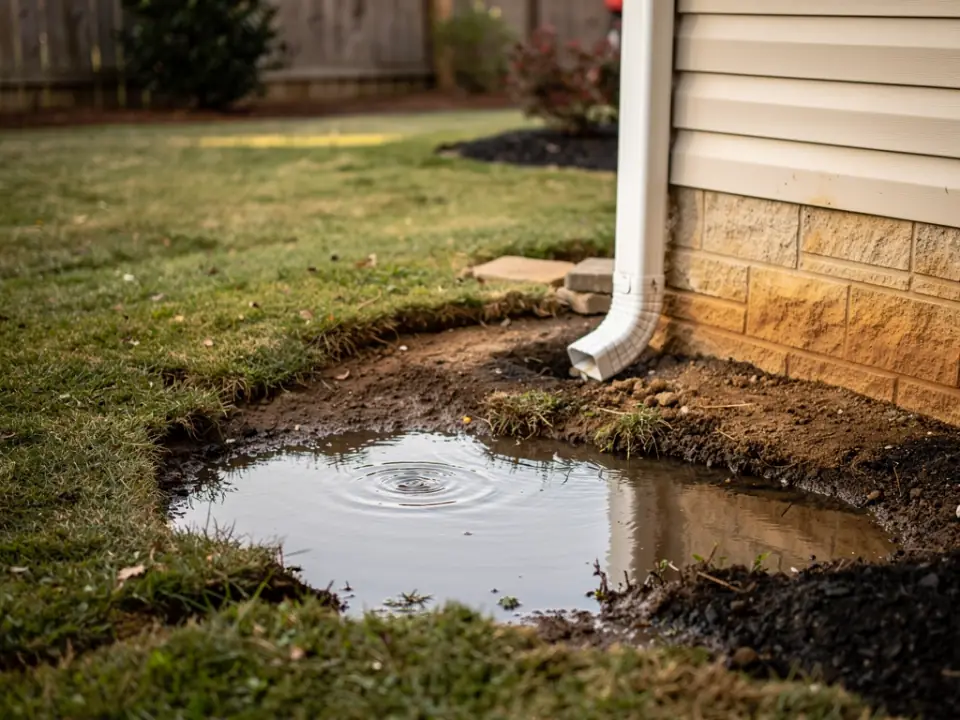
Step 1
Find where the water sits
We look at where water collects after rain and where it comes from. A low spot by a downspout is a common pattern: roof water lands on the lawn and has nowhere to drain.
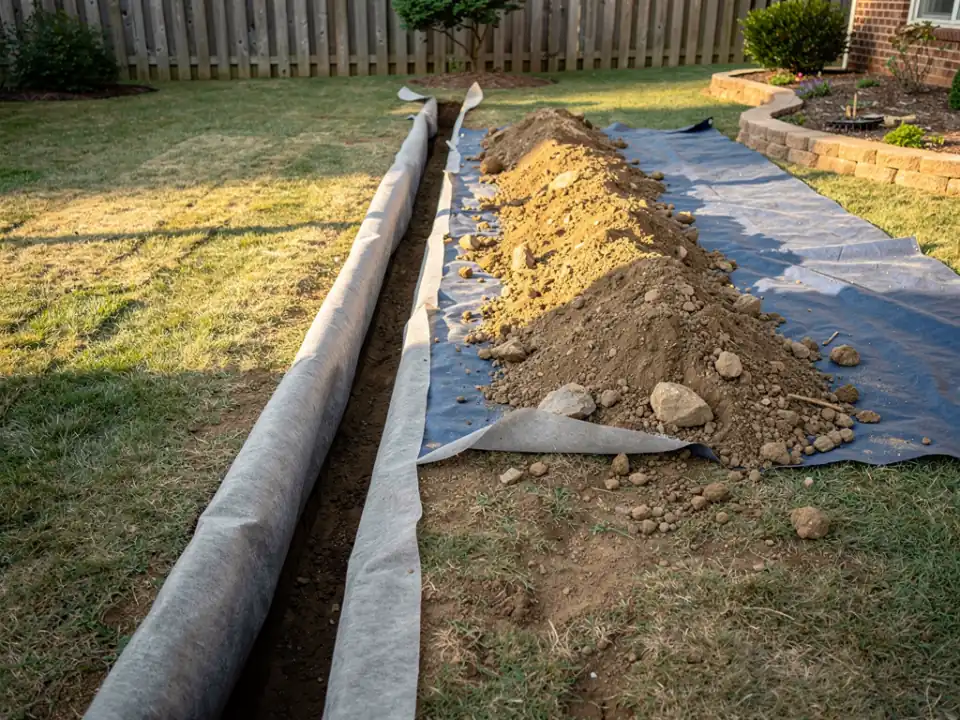
Step 2
Dig and line the trench
We cut a narrow trench across the lawn on a steady downhill fall toward the outlet. The trench is lined with filter fabric so clay silt cannot work into the stone.
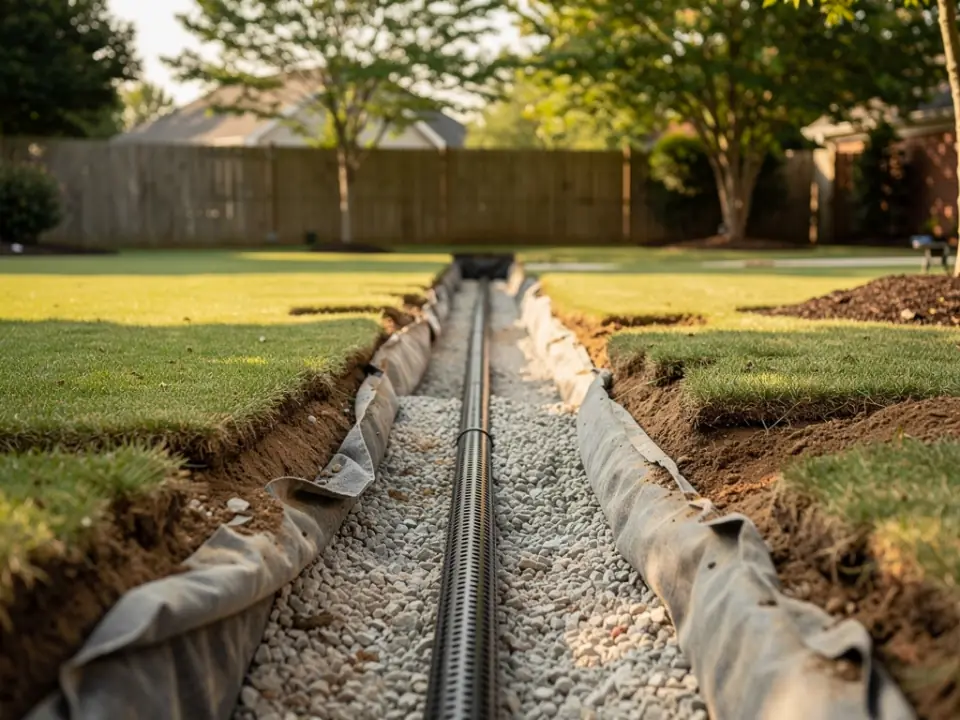
Step 3
Lay the pipe on washed gravel
Perforated pipe goes onto a bed of washed gravel, then more gravel covers it and the fabric folds over the top. Water drains into the stone, enters the pipe and runs to the outlet.
Step 4
Finish the outlet and restore the lawn
Where the pipe ends, we build a river-rock outlet that spreads the water out without washing soil away. The trench is backfilled and the lawn restored over it.
“Water used to sit by the back door for days. They found where it was coming from, put in a French drain and patched the lawn so you cannot see where they dug.”
Often built together
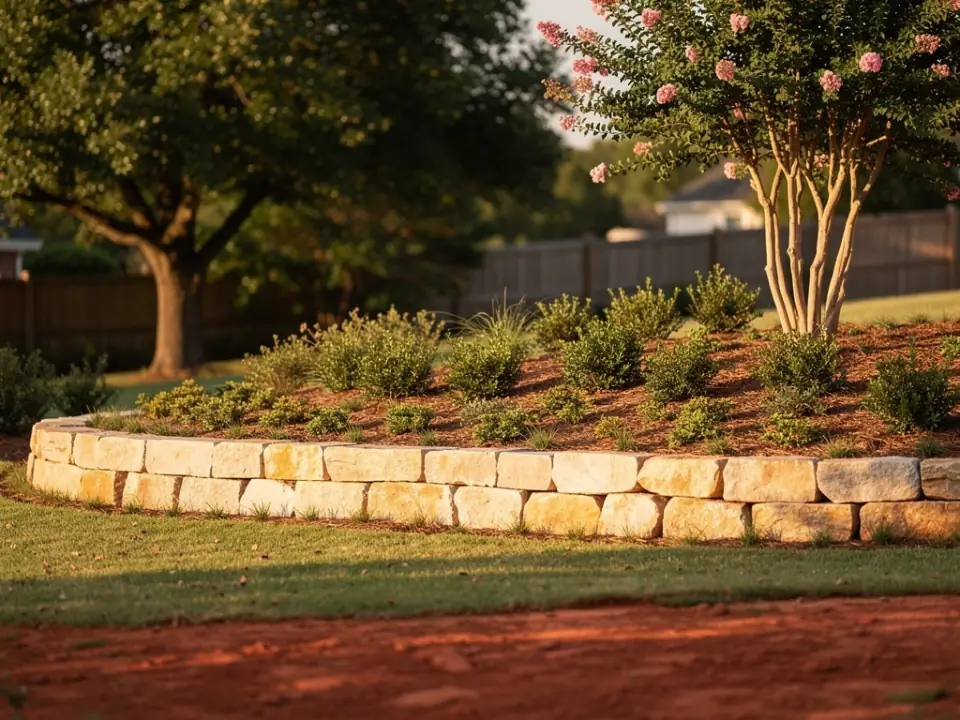
Retaining Walls
Block and natural stone walls that hold back sloped yards and give you flat, usable ground.
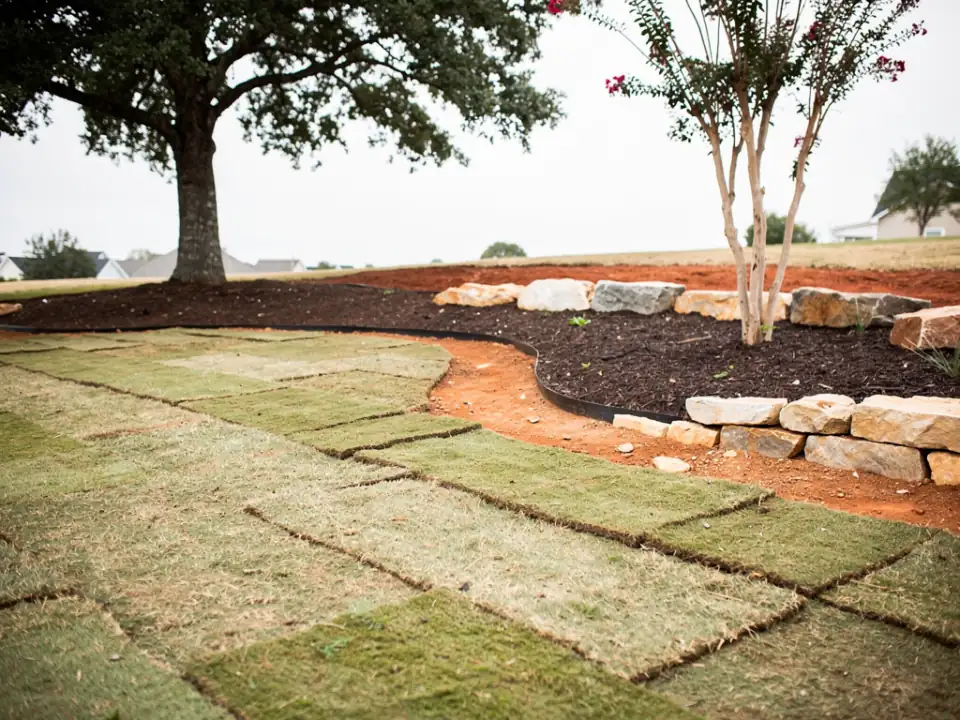
Sod Installation
Old turf stripped, clay loosened and graded, fresh sod laid tight at the seams, and a watering plan to help it take.
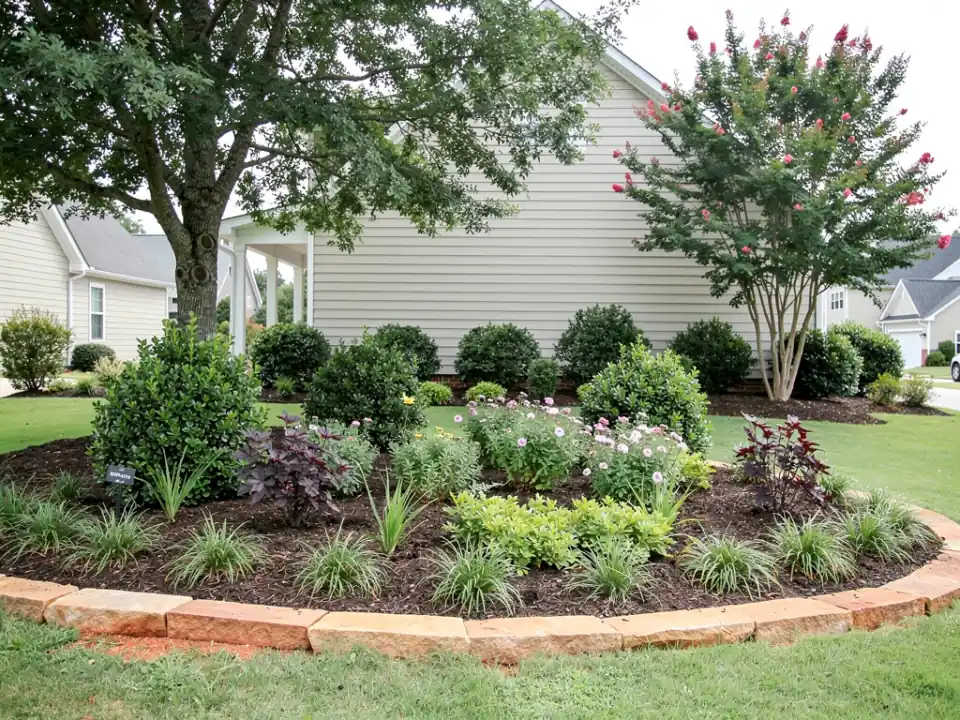
Landscape Design and Installation
New beds, planting and full front or back yard makeovers, designed and installed by one crew.
Drainage Solutions: common questions
Something else on your mind? Call (704) 555-0142.
How much does a French drain cost in Charlotte?
It depends on the length, depth, outlet and ground conditions, so we price each job in person. The on-site estimate is free.
How deep does a French drain need to be?
Deep enough to catch the water and keep a steady fall to the outlet, which varies from yard to yard. We set the depth on site.
Are there downsides to a French drain?
It needs somewhere for the water to go, and it can clog if built without fabric and clean stone. We plan the outlet first and build with both.
Can a drain help with water near my foundation?
Often, yes, when the water comes from surface runoff or downspouts near the house. If we think the problem is inside the foundation itself, we tell you so you can call the right specialist.
When is the best time to fix drainage?
As soon as you notice a problem, ideally just after rain when we can see where the water goes. We work through most of the year but avoid digging when the clay is completely waterlogged.
Do I need HOA approval or a permit for drainage work?
Some neighborhoods want to know about visible outlets or regrading near a property line, so check your HOA rules first. If your project needs a permit, we tell you at the estimate.
Get a free estimate
Tell us about your drainage solutions project. We call you back within one business day to book a time on site.
- Call
- (704) 555-0142
- Hours
- Mon-Fri 7am-5pm, Sat 8am-12pm (estimates only), Sun closed